Why isn’t reverse mortgage money taxable?
A reverse mortgage is a loan secured against your home, not income from employment, investments, or government benefits. The Canada Revenue Agency (CRA) only taxes income—not borrowed money.

Why isn’t reverse mortgage money taxable?
A reverse mortgage is a loan secured against your home, not income from employment, investments, or government benefits. The Canada Revenue Agency (CRA) only taxes income—not borrowed money.
Here’s why it’s tax-free:
You’re not earning money, you’re accessing your home equity
The funds are considered loan proceeds, not income
You’re not required to make monthly payments, but interest accrues over time
Repayment happens later—usually when the home is sold
Because of this structure, reverse mortgage funds don’t show up on your tax return.
Does a reverse mortgage affect government benefits?
One of the biggest concerns I hear is whether accessing home equity will reduce benefits like OAS or GIS.
Good news:
OAS (Old Age Security): Not affected
CPP (Canada Pension Plan): Not affected
GIS (Guaranteed Income Supplement): Not affected
Since reverse mortgage funds are not classified as income, they don’t trigger clawbacks or reductions in these programs.
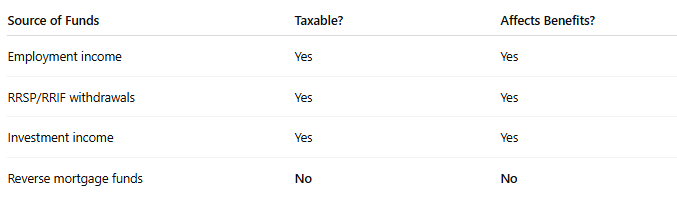
How is this different from other retirement income?
Here’s a simple comparison to clarify:
This makes reverse mortgages a powerful option for retirees who want to access cash without increasing their taxable income.
When might taxes still come into play?
While the reverse mortgage itself is tax-free, there are a few indirect scenarios to keep in mind:
1. Investing the money
If you invest the funds you receive and earn interest, dividends, or capital gains:
That investment income is taxable
2. Rental or business use of your home
If your home is partially used to generate income:
There may be tax implications when the property is eventually sold
3. Estate considerations
When the home is sold to repay the loan:
There is usually no tax on your principal residence (thanks to the principal residence exemption in Canada)
Real-world example (Canada)
Let’s say you’re a homeowner in Ontario:
Your home is worth $800,000
You take a reverse mortgage for $200,000
You receive the money in monthly payments
That $200,000:
Is not taxed
Does not reduce your OAS or CPP
Can be used freely—for living expenses, travel, or helping family
If you invest part of it and earn returns, only those earnings would be taxed.
Common mistakes to avoid
Assuming it counts as income: It doesn’t—this is the biggest misconception
Forgetting about interest accumulation: While not taxable, the loan balance grows over time
Investing without tax planning: Returns on invested funds are taxable
Not reviewing your full financial picture: A reverse mortgage works best as part of a broader retirement strategy
Who is a reverse mortgage best for?
A reverse mortgage can be a strong fit if you:
Are 55 or older
Own a home in Canada
Want to access tax-free cash flow without selling
Prefer to avoid increasing taxable income
Want to stay in your home while improving financial flexibility
Should you talk to a mortgage expert?
Every situation is different. While reverse mortgages offer clear tax advantages, it’s important to understand how they fit into your full financial plan.
As a mortgage broker specializing in reverse mortgages, I help Canadians:
Understand exactly how much they can access
Structure withdrawals in the most tax-efficient way
Avoid common pitfalls
If you’re considering this option, a quick conversation can bring a lot of clarity.
Frequently Asked Questions
Is a reverse mortgage considered income in Canada?
No. It is considered a loan, not income, so it is not taxed.
Do I need to report reverse mortgage money on my tax return?
No, you do not report it because it is not taxable income.
Will a reverse mortgage affect my OAS or CPP payments?
No. These benefits are not impacted because reverse mortgage funds are not income.
Is there any situation where I would pay tax on a reverse mortgage?
Not on the loan itself—but if you invest the funds and earn income, that income is taxable.
What happens tax-wise when my home is sold?
If it’s your principal residence, it is generally exempt from capital gains tax in Canada.
Can I use reverse mortgage money however I want?
Yes. There are no restrictions—you can use it for living expenses, home improvements, or anything else.
Is a reverse mortgage better than withdrawing from my RRSP?
It depends. RRSP withdrawals are taxable, while reverse mortgage funds are not. The right choice depends on your financial situation.
About the Author
Martine Perron is a Canadian mortgage broker specializing in reverse mortgages. She helps homeowners aged 55+ access their home equity safely and strategically.
👉 Book a consultation: https://app.arcmortgage.ca/widget/bookings/private-consultation-with-martine-perron
Get in
touch.
604-353-9254
martine@arcmortgage.ca
Team - Arc Mortgage LTD
BRX - Arc Mortgage