Do You Have to Downsize to Access Money in Retirement?
No—you have options beyond selling your home. While downsizing can free up cash, it also comes with costs, stress, and lifestyle changes that many retirees want to avoid. According to the Canada Mortgage and Housing Corporation (CMHC), most Canadian seniors prefer to age in place, meaning they want to stay in their current home as long as possible. This is especially true in high-cost markets like Vancouver, where moving may not significantly reduce expenses.


Watch: Downsizing vs Using Home Equity in Canada
If you're wondering whether you really need to move, this short video explains your options clearly:
What Does Downsizing Actually Mean?
Downsizing means selling your current home and buying a smaller, less expensive one. The difference in price becomes available cash you can use in retirement.
Pros of Downsizing
Access to a lump sum of cash
Potentially lower monthly housing costs
Opportunity to simplify your lifestyle
Cons of Downsizing
Realtor fees, legal costs, and moving expenses
Emotional impact of leaving your home
Limited affordable options in cities like Vancouver
Disruption to your community and routine
Source: CMHC highlights that both financial and emotional factors often make downsizing less appealing than expected.
What Are the Alternatives to Downsizing in Canada?
If your goal is to access money without moving, here are the main options:
1. Reverse Mortgage
A reverse mortgage allows homeowners aged 55+ to borrow against their home’s value without selling.
Receive tax-free cash
No required monthly payments
Stay in your home
Source: Financial Consumer Agency of Canada (FCAC) confirms reverse mortgage funds are not considered taxable income.
2. Home Equity Line of Credit (HELOC)
Requires income qualification
Requires monthly payments
Variable interest rates
Source: notes that HELOCs may be harder to maintain on a fixed retirement income.
3. Mortgage Refinancing
Requires income and credit qualification
May increase monthly payments
Subject to federal stress test rules (OSFI)
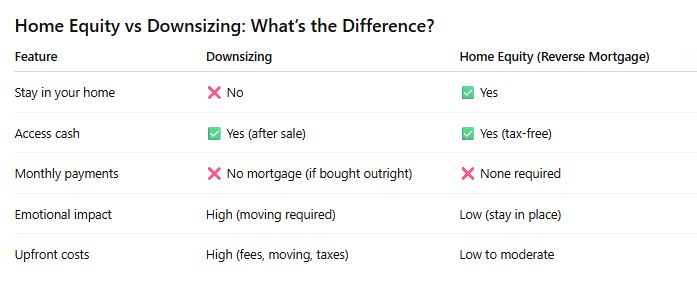
Home Equity vs Downsizing: What’s the Difference?
When Does Downsizing Make Sense?
Downsizing may be a good fit if:
Your home no longer meets your needs
You want a lifestyle change
You’re comfortable moving
You find a significantly cheaper home
However, in Vancouver, many homeowners are surprised to find that downsizing doesn’t free up as much cash as expected after costs.
When Is Accessing Home Equity a Better Option?
Staying in your home may be the better choice if:
You want to age in place
You value your current neighborhood
You need additional income or flexibility
You want to avoid the stress of moving
A Real-World Example in Canada
Let’s say you own a home in Vancouver worth $1.5 million.
Downsizing: After buying a smaller home and paying fees, you may net ~$300K–$350K
Reverse mortgage: You could access up to 55% of your home’s value depending on your age—without moving
This is why many retirees explore home equity first before deciding to sell.
Common Mistakes to Avoid
Assuming downsizing is your only option
Underestimating transaction and moving costs
Ignoring emotional and lifestyle factors
Not exploring all available financial solutions
Who Is This Best For?
This is especially relevant if you:
Are 55+ and own your home
Live in a high-value market like Vancouver
Want to increase retirement income
Prefer to stay in your home
Final Thoughts from Martine Perron
You may not need to move after all. Many Canadians are surprised to learn they can unlock the value of their home without selling it.
Downsizing is one option—but it’s not the only one, and it’s not always the best one.
If you’d like help comparing your options based on your situation, I’m here to guide you through it clearly and confidently.
Frequently Asked Questions
1. Do I have to sell my home to access equity?
No. Options like reverse mortgages allow you to access equity without selling.
2. Do most Canadian seniors downsize?
No. CMHC reports that many prefer to stay in their homes and age in place.
3. Is reverse mortgage money taxable?
No. It is tax-free.
4. What is the biggest downside of downsizing?
Costs, stress, and the emotional impact of moving.
5. Can I stay in my home and still get extra income?
Yes. Home equity solutions are designed for that.
6. Is this common in Canada?
Yes—especially in expensive housing markets.
7. How do I know which option is right for me?
It depends on your goals, finances, and lifestyle—this is where personalized advice helps.
Sources
Canada Mortgage and Housing Corporation (CMHC) – Aging in place and senior housing trends
Financial Consumer Agency of Canada (FCAC) – Reverse mortgages and home equity borrowing
Office of the Superintendent of Financial Institutions (OSFI) – Mortgage lending guidelines
About the Author
Martine Perron is a Canadian mortgage broker specializing in reverse mortgages. She helps homeowners 55+ access their home equity without giving up the home they love.
👉 Book a personalized consultation here: https://app.arcmortgage.ca/widget/booking/3XlppqW68zlsLr2daWK3
Youtube video: https://youtube.com/shorts/6dZEdsS2oAE?si=QWFv4T_gaJ5qQrZ1
Get in
touch.
604-353-9254
martine@arcmortgage.ca
Team - Arc Mortgage LTD
BRX - Arc Mortgage